Image Slider

Showing posts with label booklist 06. Show all posts

The Keep

| On
Thursday, April 05, 2007
by Jennifer Egan
This book is a layer cake, or maybe russian nesting dolls. I will spare you the tortured cake analogy I devised (there was fondant frosting of...dread!) and try to identify some of what made this book so enjoyable for me without giving away any of its twisty turns. (oh no! now I have revealed that there are twisty turns!)

The Keep has the hallmarks of a classic gothic novel: twins, ghosts, childhood trauma, shifting alliances, untrustworthy narrator(s), untrustworthy everyone else, spooky moonlight, crumbling castles, underground passageways, thwarted escape, claustrophobia, story within story -- yet there is a crackly modern energy that keeps it from being a pastiche. Being able to comment on a genre from within is tricky, but I think Egan pulls it off beautifully. I know Barbara Michaels/Elizabeth Peters did a bit of this back in the day, but hers were generally intended to be FUNNY and were often set in the past, which, while presenting difficulties of their own does allow for a little "ho ho, isn't it ridiculous that I, Plucky McGoverness, am running across the moor in my nightie chased by a wolf who may or may not be the Master of Blacktower when the moon is not full" distance. The Keep doesn't allow that kind of comic separation because it takes the world of the novel (even as it turns inside out at various points) very seriously. It does have a different distancing mechanism which I cannot reveal without giving too much away! (note to self: this "mustn't give too much away" thing is very convenient when it's hard to think of what to write.)

I first read this novel in August/Septemberish of last year and a couple of things have really stuck with me. First, I love that Egan gave a name to The Worm, that little parasite of doubt that can unfold in the gut if one is not vigilant. "Fear was dangerous. It let in the worm: another word Danny and his friends had invented all those years ago, smoking pot or doing lines of coke and wondering what to call that thing that happened to people when they lost confidence and got phony, anxious, weird. Was it paranoia? Low self-esteem? Insecurity? Panic? Those words were all too flat. But the worm, which is the word they finally picked, the worm was three dimensional: it crawled inside a person and started to eat until everything collapsed..."

Other things (beyond The Worm and the darting loop de loops the plot took in the last third) have stayed with me. She makes some "technology is the new magic" arguments which are not new, but I found them particularly interesting in the context of the gothic; I've enjoyed turning them over in my head, anyway. The other thing, which was really only glanced upon (and by a somewhat unreliable character), was the notion that many of us modern day mortals have lost the ability to amuse ourselves. Imaginations have become flabby and lazy; the convenience and constant availability of modern entertainments have removed the need to create our own songs and stories. This raised the specter of one of my multi-part perennial rants (topic of "amateur isn't a dirty word"), but that's veering off a bit further than I intend right now. (Here's a tiny bit: Not only do we no longer believe we can do it -- or have the right to do it, since it has now entered the realm of the "professional" -- but we no longer even think to try. Obviously, I don't mean people who identify as writers or painters or musicians whether they get paid or not -- I'm talking about people who are so out of touch with their own innate creativity that they think it's not something they even have a right to explore. I get really wound up about this for some reason.)

Back to The Keep: It was a lot of fun! If you like gothic stories you'll probably like it too, unless you don't like someone mucking around with the form a bit -- if that's the case, it might just make you mad. Anyway, I found the ending to be surprising (usually you can see where these things will go) but very satisfying.

Megapalooza

| On
Thursday, March 22, 2007
Have you ever found yourself wanting to clarify something because you realize (belatedly, sitting straight up in bed in the middle of the night) that you sounded exactly like the kind of pretentious jackass you were decrying, but can't think of a way to do it that doesn't just compound the problem? So, you sit down and try to think of a way to fix it (after ambulating about with it rolling around your head like a dried bean in a box), but everything you come up with is completely cack-handed, flat-footed, and wrong-headed? This is where I find myself in regard to my Light Reading Rant. I still agree with my basic point, but why do I give a damn?

The answer is not flattering. All I can say for myself is that my ire was raised when I overheard a librarian saying (in reference to romance novels for a display) "I'm proud to say I've never read one... well, I've read Jane Eyre of course." The blanket prideful refutation with acknowledgment of one "legitimate" exception is a classic snob maneuver; but my own knee-jerk anti-snob reaction is no less ridiculous. The only (feeble) defense I can offer is that this was the same woman who, when I replied "very well" to her offhand "how are you" question, said "well aren't you the luckiest girl on earth to be so (voice drops) very well," which made me want to launch into a flying tackle and punch her in the head for an hour, just like in that lost chapter from Jane Eyre.

Which brings me to Meg Cabot! I like Meg. She's a funny and unabashed feminist who loves pop culture. She's also extremely prolific. I don't have any idea how many series she has going now, but there are MANY. Her books are usually funny and romantic to some degree because that's how she does things, but she's written YA, kid's books, historical romance, contemporary romance, mysteries, etc. She writes constantly, but still finds time to post regularly to her blog about her on again off again boycott of Gilmore Girls, the one-eyed cat that will only drink hot water out of bottle caps, her opinion of The Secret, book tours (she's in Europe right now), how tough it was to give up TAB, Britney Spears and much more. She's fun and I like reading her books in the tub. (this is a compliment where I'm from!)

Finding the right thing to read when I'm in a low mood can be tough -- it can't be too heavy because I'm not really able to give it my full attention, but it can't be so stupid it makes me angry, or so predictable that I go through the motions of reading but am actually just obsessing about My Problems while moving my eyes back and forth and occasionally turning pages. Cabot manages to strike a good balance for me -- she's fun without being mindless and rewarding without being work. I know the books that fill this particular niche will be different for every reader, and it may even change for me over time; but this winter I read (and was thankful for) a lot of Meg Cabot. Here are a few of them:

The Boy Next Door: This story is is told entirely in emails , except, of course, on those few occasions when the plot requires that we be in the HERE AND NOW. Gimmicky, but tolerable. Cabot has a lot of fun with the gulf between what the main characters say to each other, and what they say to their friends. ha ha. (no, really!) This book reminded me quite a bit of the Givenchy Code , which I read in August, except it (thankfully) didn't seem to take itself as seriously. Like the GC, it's also about a young modern professional woman named Mel (what's up with that?) who lives in New York. In GC Mel was a cryptographer working as dog-walker to afford designer gimcracks and geegaws (okay, SHOES, but how much more fun are gimcracks and geegaws? Infinitely more fun!) and in this book Mel writes a gossip/entertainment column for a New York Newspaper. Her attitude toward shoes seems less urgent. Boy Next Door has a lot of the things that are typical in romance novels: the misunderstanding that two minutes of direct communication would clear up, mistaken identity, cross-dressing serial killers (briefly), a chubby best friend planning a wedding, clueless out of town parents (in both this an the GC), wardrobe dilemmas, 50lb bags of dog food and an obsession with weather disasters... but all delivered with breezy Cabot charm. That said, of the three books in this post, this is probably my least favorite.

Size 14 is Not Fat Either: This is the second book in the Heather Wells trilogy. I read the first one a year ago, and do believe I enjoyed this one more. It probably helps that the world that Heather Wells operates in is more established -- she remains a former pop princess who is now older, wiser, and wearing bigger jeans. She still has her job at a New York College residence hall, she's still living platonically with (but pining for) her ex Justin Timberlake's, I mean Jordan Cartwright's older, hotter, private-eye brother Cooper, and she's still solving crimes. This book introduces us to her father who is fresh out of Club Fed, her friendly neighborhood drug dealer and her new boss. I'm sorry to hear that this is going to be only a trilogy. I think Heather Wells could have some staying power and it will be a shame to see all the things that are just blossoming now (Cooper!, her revived singing career, going back to school, reconnecting with her father, her strained relationship with JC) tied up in a bow with the concluding novel. BUT, that's neither here nor there, I suppose. I enjoyed this, but as is the case with most mysteries and me lately, it's not for the actual puzzle or the crime, it's for the whole world that the characters inhabit.

The thing that still makes me batshit about this series is the title. It has no tie to the reality of the novel! Heather Wells used to be a skinny juvenile Britneyite and now she's a grown woman with a big butt -- in the world of this novel that's a "vanity size 8" which is, as admitted in the book, a size 10! Now, I don't care if Heather Wells is a size 6 or 10 or 18, I just think it's kind of shitty to have a "Size 14" title, and have it hang on NOTHING except for maybe some marketing theme. I applaud the sentiment, I just wish it meant something. For all my bitching, this was my favorite of the three Cabot books in this post.

Missing You: This is the fifth and final book in the 1-800-WHERE-R-YOU series. Jess Mastriani (Our Heroine), aka lightning girl, is back after a tour of duty working for the government in Iraq and Afghanistan. This book picks up a couple of years after the last one, and Jess has PTSS and lost the ability to find missing people. (which she acquired after getting struck by lightning in the first book.) She's attending Juilliard (she plays the flute) but hating it and living with her best friend from home in NYC. Then (ta-dah) her hunky but mysterious old boyfriend from the wrong side of the tracks (Indiana!) comes and asks for her help.

things I like about Jess: she's a hothead but she's compassionate, she knows she's wrong a lot of the time and struggles with it.

things I like about this series: action, hotheaded heroine who is often wrong but struggles with it, and it freely mocks the TERRIBLE Lifetime series that was made from the books (seriously, it was B-A-D). Cabot is also great sketching out distinct characters without a lot of detail. I feel like I've got a good sense of Jess's family and friends, without a ton of exposition. (although I suppose some of this could just be cumulative -- this is the fifth book, after all.)

Anyway, this is another one of the series (like the late lamented Mediator) that Cabot seems to be tying up so she can move on to other things. I think as a series I liked Mediator better, but that might be because it was so clearly inspired by Buffy. But I digress! This is a fun quick read, but if you're interested I would recommend starting at the beginning of the series (When Lightning Strikes).


(this image came up INEXPLICABLY while I was looking for book covers. Liberace and Sam the Eagle seemed too good to leave off, so here they are.)

catch-up books

| On
Thursday, March 08, 2007
I am so behind with book things! These three are all from 2006. (edit: I should say I READ them all in 2006. They were published in 2003, 2005, and 2005 respectively.)

The Little Black Book of Stories by A.S. Byatt: I am a big fan of Byatt's short work. Some of my favorites are her fairy tales (particularly "Cold" from her Elementals collection; it's the one about the (literal) ice princess who marries a fire prince. It ends as happily as ever happens in an A.S. Byatt story, but not without difficulty. It's great -- read it if you haven't already.) I had the realization reading this collection that I generally prefer her stories which have some sort of mysterious or fable-like quality. The reason isn't just because she writes so well in that milieu, but because she writes so well and so convincingly about what absolute bastards human beings can be to each other in the so-called real world; it's uncomfortably raw without that fantastical buffer. Not that readers shouldn't be made uncomfortable, but... man. She's really good at it.

In this collection, I loved the first story The Thing in the Forest. Two little girls who have been evacuated to the country from Blitz-era London witness something nasty in the woodshed. Er, woods. Byatt is so adept with descriptive language -- this first example is from before the girls run across the Thing in the Forest: "They sniffed the air, which was full of a warm mushroom smell, and a damp moss smell, and a sap smell, and a distant hint of dead ashes." And here's a later, Thing-related description which seems very Alice in Wonderland to me: "A crunching, a crackling, a crushing, a heavy thumping, combined with threshing and thrashing, and added to that a gulphing, heaving, boiling, bursting steaming sound, full of bubbles and farts, piffs and explosions, swallowings and wallowings." She creates a palpable sense of dread, which turns out to be well-founded. I read this story in the fall, and it is perfectly suited to pre-halloween. (or any time you fancy some keen writing!)

The Stone Woman was creepy but moving; a story of unasked for but spectacular metamorphosis. Raw Material is about a writing class. It was funny to start, (which surprised me as it's not something I expect from Byatt),but it is, of course, so much more. A solid collection -- the other two stories were also good, but honestly they depressed the hell out of me.

The Believer Book of Writers Talking to Writers -- Vendela Vida, editor: So good -- even when I was completely at sea as to who these writers were (often), or what they wrote (even more often), the interviews are presented in such a way that it did not matter! I know it may sound like the longest drag in dragsville, but reading such a variety of writers talking about how they do what they do, or what they themselves like to read, or what inspires or obsesses them set off little cherry bombs in my brain. It's not only entertaining, but satisfying and edifying. It left me with a long list of things I want to read, and a short list of authors I was already looking at squinty-eyed and now feel free to avoid. This is a very easy book to just sort of dive into and read a little or a lot.

The Disappointment Artist by Jonathan Lethem

This is only the third book by Jonathan Lethem I've read. I know, I know -- not many, but at least they're varied and not all hunkered down at one end of his catalog:

Gun, With Occasional Music: Kangaroo Detective Noir
Motherless Brooklyn: Freaking Brilliant (autistic detective, but with a lot more heart than you get in a Kangaroo Noir novel)
ooh -- I also saw him read at Powell's from Fortress of Solitude, but have yet to read that novel.. (he's taller than I thought, and also more attractive than pictures would indicate. Or maybe he's just the kind of charismatic yet self-deprecating nerd who emits pheromones at my frequency.)

Now I can add The Disappointment Artist to the list. It's a book of personal essays, some of which are more personal than others. What I like about this collection is that he is completely unafraid to report qualities in himself that are unattractive. You know how it is... someone will write that they were picked on by bullies because they liked to read and were misunderstood. Lethem will write similar, but he also includes that he was a neurotic pain in the ass. There's a sort of aggressive honesty in a lot of these essays that I really responded to -- it's not that he's daring the reader to dislike him, he just seems to be interested in rendering the most accurate picture of the time, place, or situation and is willing to do what it takes to get there. Here's a little sample from the essay titled 13, 1977, 21
1. In the summer of 1977 I saw Star Wars--the original, which is all I want to discuss here--twenty-one times. Better to blurt this out at the start so I'm less tempted to retreat from what still seems to me a sort of raw, howling confession, one I've long hidden in shame. Again, to pin myself like a Nabokovian butterfly (no high-lit reference is going to bail me out here, I know) to my page in geek history: I watched Star Wars twenty-one times in the space of four months. I was that kid alone in the ticket line, slipping past the ushers who'd begun to recognize me, muttering in impatience at a urinal before finding my favorite seat. That was me, occult as a porn customer, yes, though I've sometimes denied it. Now, a quarter century later, I'm ready for my close up. Sort of.

It is funny and heartbreaking both, and not the only essay in the collection to be so.

Radio On: A Listener's Diary

| On
Friday, January 12, 2007
by Sarah Vowell
This book is a time machine to twelve years ago. Newt Gingrich had just led a revolution to the republican controlled house and senate, Kurt Cobain had been dead for less than a year, and 9/11 hadn't happened. It makes a body nostalgic for the days when all it took to work up righteous indignation was Rush Limbaugh and Newt Gingrich. What the current president does on a daily basis is so much worse... Rush barely gets a rise out of me anymore and Newt is trotted out on cable news shows to be the reasonable republican. But this book isn't just a historical document of What Was Happening and/or Playing on the Radio, it's also about What She Was Thinking (about what was happening and/or playing on the radio). Since the she in question is Sarah Vowell, well... I wanted to read it.

Radio On is a loving yet prickly snapshot of America in 1995. She listened all over the country and all over the dial. It's about her, it's about America, it's about all of us. This text will be a gold mine for some kid in 2050 who has to write about the political atmosphere of the late twentieth century. This is not my favorite Sarah Vowell book -- it may even be my least favorite. The daily diary format allows for a lot of random bitching (hello, blogworld!) that would probably be edited out of a regular essay. It's kind of messy and distracting, but on the other hand I think some of the most telling and honest parts come out of the mess. Oh, hell. Just read it and see what you think.

ANYWAY, this is great fun to read. I love how she writes about music and believe it or not, how she writes about Rush Limbaugh.

Fables Vol 6: Homelands

| On
Saturday, January 06, 2007
by Bill Willingham
More big fun from the Fables franchise. The first half of this book is about Jack (you know, Jack Horner, Jack of the Tales, Jack be nimble, Jack and the beanstalk) -- the blond troublemaker/ con artist who always takes the shortcut and always gets his ass handed to him as a result. Jack decides to leave Fabletown (because they don't appreciate him there) and move to Hollywood to seek the fame and respect he thinks he deserves. He becomes a big mover and shaker (thanks to a huge pile of stolen Fabletown money) and starts his own studio. Things, as you might imagine, don't go well for long.

The second half of this collection deals with the ongoing story of The Adversary. Blue (Little Boy Blue, who's not so little, here) comes into his own going deep into enemy territory. He has what they call the Jabberwock's Bane (the vorpal sword!) so the words "snicker-snack" appear a satisfying number of times as he fights his way to The Adversary... whose identity is revealed! (But I won't say who it is.) Anyway, there's no Snow or Bigby or Rose Red in this one, but we get to spend time with some of the previously minor characters and some new (to the series) characters -- Mowgli, Bagheera, the Snow Queen. To sum up: fairy tales, vorpal sword, a lot of fun.

Icelander

| On
Friday, December 29, 2006
by Dustin Long #34

Oh, Icelander! (I think I am going to start every blog post with "oh!"... okay, maybe not.) Some things about this book:

1) for reasons I do not fully understand, I have always wanted to stay in an ice hotel. And ICELAND, by dint of having ICE as part of its name, always comes to mind. I think this means I was subconsciously primed to be receptive to a book by this title, or possibly it means nothing at all beyond "I want to stay in an ice hotel."

2) I read a review of it in the Believer that made me say "I must read this book!" It is a McSweeney's Rectangular (and it is indeed rectangular!). Except now I can't find that review, so maybe I read it somewhere else. At any rate, this mysterious review that I read somewhere obviously did not spring fully formed into my head or the one I am writing right now would be much more coherent (one would assume), but it did make an impression.

3) once acquired from the library, the back flap further informed me that it was an "intricate giddy romp steeped equally in Nordic lore and pulpy intrigue." I found this Most Appealing. There are steam tunnels and skaldic karaoke and the main character is called Our Heroine, which also piqued my curiosity. Promises were made that "adventure ensues." And it does! (If anything should ensue, it should be hijinks or adventure. Misery, calamity and the like should never ensue (they can befall, if they must) -- okay, maybe calamity can ensue, but I draw the line at misery.)

4) The book is a physical pleasure to read and hold. It's a hard cloth(ish) cover with the picture embossed, and is a great size for carrying around. It also has THE NICEST paper and binding it has been my pleasure to read all year. (don't get me started on how the price of books has gone up, up, up, yet they often put crappy mass market paperback paper inside a hardcover. Uncool, publishing industry, uncool!) The paper is bright white and smooth, the book has a nice spine that I can hold open with one hand, unlike some books that seem more like bear traps.

5) I started out thinking that this story was too clever by half and it was reminding me of Jasper Fforde's Thursday Next series (of which I read the first one and half of the second). But as I got further along and acclimated to the world of the book, I enjoyed it more and more; any Fforde comparisons became "wow! I like this so much better." (The Fforde books are ones that I want to love but can't. I've been thinking about it, and for me it seems that he's so busy amusing himself with how clever he is, he forgets about his responsibilities to the story and to the reader. I know that lots of people love him, but that sense of self-indulgence (and how good they COULD be) is what I get hung up on.) I imagine there were many more tangents and side roads Dustin Long could have taken, but didn't because he was being more considerate of the story. I for one appreciate it!

6) I am not going to attempt to sum up the plot -- there is just TOO MUCH. It's a PoMo mystery. There are stories within stories, footnotes from an increasingly suspect source, trouble in academia, the nameless girl detective with a famous dead mother, a wolf, a witch, a festival, an actor, a Two-Story House... I ended up really enjoying it, even as I was sure I was missing about half of what was going on. I think it would not only hold up on re-read but have even more to offer, which is one of the things I like most about books.

Sailing Alone Around the Room

| On
Monday, December 11, 2006
by Billy Collins #33

Oh, Billy Collins! Some authors are so potent I can't read more than one of their books in a short period of time -- I get burned out or bummed out. Everything I liked about the one book may be repeated in the second, retroactively sucking the joy out of the first one. So I wait a while, and it usually works out. I read my first Billy Collins collection not that long ago, but I thought maybe poetry would work differently than prose in my Not Too Close rule. I was right. If anything, I like him more now than I did then.

Why? He's conversational and witty without being obnoxious. He shares a lot of himself, but there's a lot held back, too, which makes me think he'd be really interesting conversational partner -- like he could surprise me with some crazy idea that I would then enjoy thinking about for days afterward. I like him. (I do not feel this way about every poet or author I admire.)

I've been trying to remember where I read my first Billy Collins poem, and I think the first may have been one someone linked to, in response to another poem on this blog. I know I was impressed enough with this dress poem, which showed up on Dressaday that I saved it into my journal. (it turns out he writes really well about clothes.)

Anyway, here is an excerpt that I had to include for it's Cherry Ames reference, since I read a lot of Cherry Ames (and even some Vicky Barr), back in the day. This bit is from the poem titled Canada

O Canada, as the anthem goes,
scene of my boyhood summers,
you are the pack of Sweet Caporals on the table,
you are the dove-soft train whistle in the night,
you are the empty chair at the end of an empty dock.
You are the shelves of books in a lakeside cottage:
Gift from the Sea by Anne Morrow Lindbergh,
A Child's Garden of Verses by Robert Louis Stevenson,
Ann of Avonlea by L.M. Montgomery,
So You're Going to Paris! by Clara E. Laughlin
and Peril over the Airport, one
of the Vicky Barr Flight Stewardess series
by Helen Wills whom some will remember
as the author of the Cherry Ames Nurse stories.

What has become of the langorous girls
who would pass the long limp summer evenings reading
Cherry Ames, Student Nurse, Cherry Ames, Senior Nurse,
Cherry Ames, Chief Nurse,
and Cherry Ames, Flight Nurse?
Where are they now, the ones who shared her adventures
as a veterans' nurse, private duty nurse, visiting nurse,
cruise nurse, night supervisor, mountaineer nurse,
dude ranch nurse (there is little she has not done),
rest home nurse, department store nurse,
boarding school nurse, and country doctor's nurse?
(end excerpt)

And then there is this poem, which is the last one in the collection. One of the things I like about Collins is his ability to be kind of meta about poetry or the act of reading or writing without being annoying. (I also think there is a little resonance here with blogging.)

The Flight of the Reader

You'd think we would have had enough
of one another
after all the rain streaming down these windows,
the walks out to the garden when it clears,
the same yellow and white flowers,
all the sleepless nights ---
the toy car going in circles on the bed table.

But still, you stay perched on my shoulder,
cricket or bluebird,
wild parrot digging your claws into my loud shirt.

Is it because I do not pester you
with the invisible gnats of meaning,
never release the whippets of anxiety from their crates,
or hold up my monstrous mirror,
a thing the size of a playing field?

Whatever makes you stay,
I hate to think of that morning
when I will wake up and find you gone,
heading toward the open sea,
dragging the cables that bound us together,
leaving me with nothing more to say.

But don't get me wrong.
It's not that I can't live without you,
cannot sit under an ordinary green tree
with no desire to reach for the pen in my pocket,
or lie contented on the couch all day,
one hand over my mouth.

It's not like I have a crush on you
and instead of writing my five-paragraph essay
I am sailing paper airplanes across the room at you---
it's not that I can't wait for the lunch bell
to see your face again.

It's not like that. Not exactly.

(Billy Collins)

And Now You Can Go

| On
Monday, December 04, 2006
by Vendela Vida #32

This book is one of those that has so much to offer it could be 100 things to 100 people. A book about surviving a violent crime? Okay. A book about the pleasures and dangers of living in New York, San Francisco, or (briefly) the Philippines? Uh huh. A book about families, friends, lovers and how they can love you and want to help, but still not get it and make things worse? Yeah, alright. A reminder that some things you have to do yourself? Indeed. A mystery? Yes. A delight to read, despite dealing with violent crime and missionary work? Definitely.

What spoke the most to me was how gracefully Vida handles the complex nature of forgiveness -- that it is at once a selfish and generous act. (whenever the topic of forgiveness comes up, it makes me think of the excellent Buffy the Vampire Slayer episode I Only Have Eyes For You, where Buffy is feeling understandably betrayed by Evil Angel and taking it out on the MoTW ghost by saying he doesn't deserve the forgiveness he seeks. Giles tells her "To forgive is an act of compassion, Buffy. It's not done because people deserve it. It's done because they need it," which always struck me as being one of those lessons that once learned makes life so much better.)

Anyway... Vendela Vida was the one participant of the Sassy Stories panel I saw at Wordstock who did not trip my irritation mechanism, so I was most pleased to see that it was no fluke. My mechanism is calibrated correctly! The book is really good, but if that weren't reason enough, how about because her name is so delightful to say? Vendela Vida, Vendela Vida... try it a few times and you'll see what I mean! (is that creepy? I don't mean to be creepy. Maybe you should just get the book and say the name quietly to yourself...)

Burlesque {and the New Bump-n-Grind}

| On
Sunday, November 12, 2006
by Michelle Baldwin #31

Here's another title from the backlog. I found this browsing in the library waaaay back in July. I wasn't looking for the burlesque section specifically (that's the 792's, stage productions for you dewey decimal fans) but was in the general 700's art section because occasionally some wonderful thing will leap out of the stacks at me.

What does the word Burlesque bring to mind? Feathers and spangles? Yeah. Tassel twirling? Certainly. The Simpsons episode Bart After Dark, where Bart breaks a window and ends up working the door in the Springfield Burlesque house? Yes! Gypsy Rose Lee? Of course! (a friend worked for Gypsy way back when, so I always look for Gypsy.) This book had no mention of the Simpsons, but the other areas are amply represented.

Baldwin gives a great overview of Burlesque and its place in entertainment -- both historical and modern -- from early British dance hall to the "Golden Age of Burlesque" during the 20s-30's to the modern revival. How can you not enjoy reading chapters that feature Sophie Tucker, Mae West, and the words "hoochy-kootchy"? Christina Aguilera could learn a thing or two about saucy but not too complicated double entendres from these early chapters.

One of the things that appeals to me about the idea of burlesque is the cheekiness factor. There is a sense of sexy fun which seems to be missing from most modern half-naked entertainment. Let's take music videos for example: there are often half-naked people, but they usually look dead-eyed and vacant as they grind their way through choreography designed to highlight enormously out of proportion fake breasts. On the other hand, tassel-twirling makes me laugh. It's so absurd, but strangely celebratory.

Speaking of big fake boobs, many modern burlesque troupes, while certainly more tattooed than their predecessors, take pride in having members who have not been surgically enhanced; i.e. no boob jobs! I think there's a whole generation of people growing up now who have no idea what natural breasts look like (or natural teeth, or non giant lips, or bumpy noses...). I just don't understand how something that looks like half a coconut forced under the skin is considered attractive, but I digress...

Many performers make their own costumes, design their own routines, make their own posters... so while yes, they are shaking what their mama gave them on stage, it is done with deliberation and specific intent by the artist herself. I guess this is why burlessque dancing doesn't seem demeaning to me, whereas music video hoochie dancing does. (I readily acknowledge that whether or not something seems demeaning to me really doesn't matter outside of my own head, since I am not the arbiter of these things.)

The early days of burlesque were all about comedy and sexiness combined. Comedians would come on between acts, not unlike a variety show (think the Muppet Show!) except with more spangles and exposed flesh. The natural outgrowth of this model brought the stars of the striptease like Gypsy Rose Lee, Lili St. Cyr, and Ann Corio. (I love this quote of Corio's opinion on what she saw as an unfortunate reliance on gimmicky props by other practitioners, "Corio felt that a good teaser had no need for gaudy props. 'A woman's greatest asset is a man's imagination.'" Which goes to show that it's the same as it ever was as far as how much is too much, I suppose.)

Lest you think the whole book is an historical overview, it's not. Baldwin spends a lot of time looking at the range and depth of the new burlesque -- from the old variety show model to acrobatics to the elegant "peelers" to song and dance cabaret to performance art, and so on. There is also time spent on exploring the difference between modern stripping and burlesque. (There are heated feelings and opinions about this, as you might imagine.) I particularly enjoyed reading the trade-specific vocabulary: peelers, teasers, baggy pants comics, tassel-twirlers. Also it's hard to beat the the names of the "classic burlesque stripteases such as the fan dance, champagne bath, birdcage and spider web." Like most language specific to a subculture that one is unfamiliar with, it all seems so exotic and evocative. If you have any interest at all in the subject, I think this is a very good book to start with.

These bottom two pictures don't have much to do with THIS book, but in the course of looking for photos to illustrate this post, I found these, which had to be included. Gypsy Rose Lee wrote a murder mystery called The G-String Murders (old paperback photo below). The picture I really love, though, is the one of her writing it. I know it's a publicity picture, but I adore the piles of paper all around her!

The Givenchy Code

| On
Sunday, October 29, 2006
by Julie Kenner #30

This is a fun book, but I feel like I need to qualify the fun. This makes me wonder if the reader feels the need to qualify, is it really fun? The answer in this instance is yes. After all, there are many kinds of fun, and one of them is that dizzy feeling caused by frequent eye-rolling and rapid page turning.

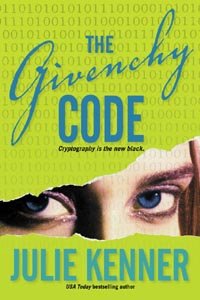
Let's start with the cover -- for a chick lit book (and oh, how I loathe that term, but it is what it is) this is fantastic. No cartoons! No shopping bags! A cool torn-paper effect with just some made-up eyes to indicate the chapters spent on grooming within. Best of all is the acid green color with binary code superimposed over everything. It calls out to my childhood girl-spy fantasies, I suppose. Anyway, somebody in the marketing department did a really great job.

On the cover there is also the promise that "Cryptography is the new black." IF ONLY, is what I say. Here's where the eye-rolling begins. This story is a mess, but maybe "mess" is too strong. Hideously compressed is probably more fair. The gist, and I don't think I'm giving anything away here, is that our heroine, Mel Prescott, gets sucked into a real life version of an online game called PSW (for Play. Survive. Win.) in which (through some vague hand-waving) there is an assassin out to kill her, a dude sent to protect her, and a bunch of clues that she must solve in a timely manner... or DIE. (Do you suppose the guy sent to protect her is a tortured but handsome noble ex-marine of few words, but much sexy action? You suppose correctly.)

Anyway, Mel is a smarty pants with an interest in cryptography (which is cool -- I actually wish they'd spent more time on code stuff) who is also a brand-snob shopping addict who works a million jobs to support her 5th Avenue habit. This second aspect became tiresome. Not because I'm anti-shopping, or anti-girlie stuff at all, but because... well, because it seemed cribbed from the fall-fashion issue of Vogue and Sex and the City then stapled with the edges crooked to her smarts in order to approximate depth. It was "blah blah Brand Name, blah blah I LOVE SHOES, blah blah, enigma machine."

Speaking of the city... this novel takes place in New York and features the most superficial rendering of the city I've read in a while. There is no real sense of place, except for things that could be copied out of a not particularly inspired guide book. (Look, it's the Statue of Liberty, it's Grand Central Station, it's the Plaza Hotel, it's St. Patrick's Cathedral, it's... Madison Avenue.) Actually, this reminds me in some ways of a movie novelization! I think the story wouldn't seem so thin if there was more time spent on grounding the ridiculous plot in a real setting, which I think could be done visually. Anyway, this reads like an awful lot of bitching for something I did enjoy. It is just about the perfect bathtub book, and I mean that as a sincere compliment. (it's not too heavy, it stays open, the paper is the kind that dries really fast if your fingers are wet, the chapters are really short if you decide to take a nap, etc.)

The Dead Beat

| On
Sunday, October 15, 2006
by Marilyn Johnson #29
Full title: The Dead Beat: Lost Souls, Lucky Stiffs, and the Perverse Pleasures of Obituaries

I saw Marilyn Johnson read at Wordstock, and I liked her very much, but her book is even better! Before I get to what's inside, let's address the size and shape of this book. I don't know why, but the fact that it is sort of tall and skinny (5.25" x 9.25") made for an even more enjoyable read. I'm undoubtedly making too much of the physical pleasure of just holding this book, but I tell you -- publishers today are cheaping out on bindings and paper (don't get me started on the state of the trade paperback!), so when one is distinct, it deserves mention. Plus it sort of looks like a headstone, which is appropriate to the subject matter.

Here is a fact: we're all gonna die. Here's an opinion: we have a profoundly unhealthy and unbalanced attitude toward death and dying in this country. (also aging, the poor, sex, and the importance of art in society -- but that's not what this book is about so I'll leave it alone for now.) This book helps redress the balance.

Johnson tackles the obituary from many angles -- the obits themselves, the culture of obituary hounds, and the people who write them. I particularly like the look she takes at the differences between US obituaries and those published in the UK. Here's an excerpt discussing "the code." She's talking of Hugh Massingberd, "the master of the euphemism," who wrote for the UK paper the Daily Telegraph

This coded understatement is an art, and part of the pleasure of reading and writing obits. Massingberd spent his career at the Daily Telegraph refining that art. "We all know 'he didn't suffer fools gladly' translates as ' a complete bastard,'" he told a gathering of obituarists in Bath, England. Massingberd is a great elegant bear of a man, and in a self-penned mock obit claimed to possess "an appetite of such magnitude that friends counted him as three men at their table." He smacked his lips over his list as if it were a tower of profiteroles, then read it with lusty pleasure:

Gave colorful accounts of his exploits -- Liar!
No discernible enthusiasm for civil rights -- Nazi!
Powerful negotiator -- Bully!
Tireless raconteur -- Crashing bore!
Relished the cadence of the English language -- Old windbag!
Affable and hospitable at every hour -- Chronic alcoholic!
He was attached to his theories and sometimes urged them too strongly -- Religious fanatic!
Fun-loving and flirtatious -- Nymphomaniac!
An uncompromisingly direct ladies' man-- Flasher and rapist!

(end quote)

There is poignancy in this book as well, but predominantly a joy for stories, an enthusiasm for the small details that distinguish us one from another, and the impression that you don't honor the dead by whitewashing or neutralizing their lives.

The thing that's really stuck with me all these months (this is another one of those posts that has been staring at me from a list of Things To Do) is how a great obituary is not about death, but about how one LIVED. One of the things I took away from reading this is that I would like to have something more meaningful (or colorful -- it doesn't have to be both) than "she really knew her way around some keyboard shortcuts" in my obituary! I guess it's never too late to start my career in international intrigues, roguish adventures, making things from lint, or at the very least giving colorful accounts of my exploits in fun-loving flirtatiousness.

King Dork

| On
Wednesday, September 20, 2006
by Frank Portman #28

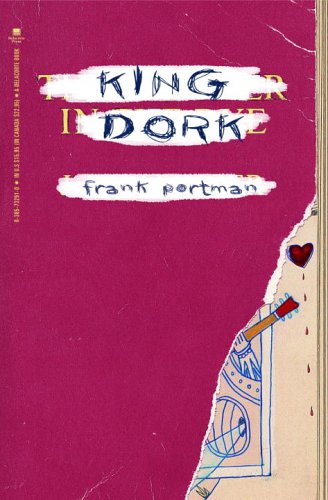
I enjoyed this book so much it has been difficult for me to figure out how to write about it. I've been putting it off for MONTHS, and now I've had to go back to look around for things I half-remembered and wanted to check on and ended up reading a lot of it again. It's that kind of book.

Question: As a woman in my thirties, should I be concerned that I found King Dork, a Young Adult novel written in the first person voice of a fourteen year old boy, and considered by some to be a quintessentially "guy's book," to be so entirely relatable and one of the best novels I've read in a long time?
Answer: No. Good is good, and this IS REALLY GOOD. It probably doesn't hurt that it hits a lot of your quirk buttons, though.

Question: oh, really?? I don't suppose you mean my innate good taste and appreciation for a well-written and engaging story.
Answer: You know what I mean!

Question: do you have to make me sound like some sort of pervert? can't you just answer the question?
Answer: Well, since you brought it up, I will mention that this book is sexually frank and forthright, sometimes raunchy but not skeevy. But you probably think you're talking about the music, the mystery, the mods, the brilliantly drawn characters, the keen observation of high-school hell, the obsession with vocabulary....

Question: That's more like it!
Answer: that's not a question.

Question: Just shut it, will you?
Answer: I know it doesn't cost anything to post this, but don't you think you could make better use of your resources?

Question: Who's asking the questions around here?
Answer: ...

Question: Is the answer provided to the question "what is the best rock band of all time?"
Answer: yes.

Question: The 15th best rock band of all time?
Answer: yes.

Question: Did you find Tom Henderson (aka King Dork, aka Chi-Mo), our narrator, to be self-aware to an unbelievable degree?
Answer: No. He IS highly self-aware, and in lesser hands it would seem like a total bullshit author self-insertion, but he's ... I don't know. I bought it. He was breaking my heart and cracking me up simultaneously on just about every page, but all in a way that seemed believably fourteen.

Question: Did it remind you a little of Freaks and Geeks ?
Answer: at first, mainly because there is a Sam in both of them and both the book and the series are dealing with being completely socially unfit in high-school. And the army jacket, oddly. But other than that they separated pretty quickly in my mind (while both remaining excellent).

Question: Can you give me that quote, you know the one where Tom is being all insightful, wise, curious, yearning, fourteen and FUNNY all in one paragraph?
Answer:Well, there are certainly lots of those, but I think this one fits the bill. It's on p.133 where he is wondering what "sweet, ordinary boyfriend-girlfriend things" might be with Fiona. (or Fake Fiona):
"I only mention it because I have this idea, a dream, really, that part of what it would mean is that the boyfriend is in this little club with the girlfriend where when one is hurt or troubled or being assailed by the cruelties of the world, the other decides not to be on the side of the world, but to join forces with the other member of the club against the world, even if it is frowned upon, even if it's a doomed scenario, even if the world is definitely gonna win. Like you're allies. The last remnant of your people. A Sex Alliance Against Society. But maybe I have it all wrong. It does sound like a quaint, far-fetched idea, now that I've put it in words. And also overly dramatic, if something can be o. d. and q. at the same time."

Question: is there a glossary, and if so, is it hilarious?
Answer: yes and yes!

Question: Why are you so stingy? Can't you see I was totally hinting around for an example?
Answer: It's not like you're subtle.

Question: Look, will you give me an example or not?
Answer: okay. But don't be expecting everything to go your way because I capitulated on this one thing.

Question: ... am I having this argument with MYSELF?
Answer: ::sigh:: you don't want to know. Here is your glossary entry:

normal (nor-MAL): lacking in taste, compassion, understanding, kindness, and ordinary human decency.

The Trouble With Poetry and other poems

| On
Saturday, September 16, 2006
by Billy Collins #27

I don't know how I came to get this book from the library. Maybe I read an interview with him online? Maybe somebody said "hey, that Billy Collins... you should check him out"? Who knows. It's been so long now I can't quite remember, but I do know it was after I determined I should be reading more poetry. This is all to say that I was aware of him, (poet laureate 2001-2003 , founder of the useful and wonderful Poetry 180) but hadn't really read him. (I am frightfully unread, it's true. I just pick and poke my way through the stacks and shelves and reviews looking for the next obsessive rabbit hole to fall into. It works pretty well from a personal satisfaction standpoint, but not so well for having a really solid foundation in things that everyone has read. So, if the question is "have you ever read XYZ?" my answer will probably be either "no" or "not yet," or maybe the classic deer in the headlights stare while I try to figure out if I've even heard of it.)

Anyway, back to Billy Collins, who does not deserve to be stuck in a blog post with a bunch of self-obsessed literary excuse-making, but that's the nature of blogging (and also the nature of me writing after midnight!), so here we are.

A word that comes up a lot when reading about Collins is "accessible," which is certainly true, but... talk about damning with faint praise. He should receive bold praise! He IS accessible, he DOES use "simple, understandable language" (thank you USA Today for that succinct bit of criticism), but he is also wickedly smart and insightful with a dry, sly sense of humor. Which isn't to say that it's all hahaha the poet laughs at you, mortal. He's able to combine all those threads (the wise-ass thread, the beloved thread, angry thread, etc.) with sadness and vulnerability in a way that is so human and relatable. And good.

I recommend listening to either (or both!) of his CDs. He sounds, I found, just like I thought he should, although before I heard him I had no idea how that would be. (It will all make sense after you hear him, trust me.)

Here's another quote (from the back of the book -- I'm really doing my homework on this one): "It is difficult not to be charmed by Collins, and that in itself is a remarkable literary accomplishment." The New York Review of Books

It was hard to pick which poem to put in this post -- there are others I liked better, but they were long and it's late, so I chose this one (which I also quite like):

On Not Finding You at Home

Usually you appear at the front door
when you hear my steps on the gravel,
but today the door was closed,
not a wisp of pale smoke from the chimney.

I peered into a window
but there was nothing but a table with a comb,
some yellow flowers in a glass of water
and dark shadows in the corners of the room.

I stood for a while under the big tree
and listened to the wind and the birds,
your wind and your birds,
your dark green woods beyond the clearing.

This is not what it is like to be you,
I realized as a few of your magnificent clouds
flew over the rooftop.
It is just me thinking about being you.

And before I headed back down the hill,
I walked in a circle around your house,
making an invisible line
which you would have to cross before dark.

E. E. Cummings: Selected Poems

| On
Friday, September 01, 2006

edited by Richard Kennedy #26

I wasn't going to write this up now since I just did a poetry book and I read this over a month ago and you know, it could wait. But Rosie O' Donnell and the Associated Press have forced my hand, those bastards! Here's the responsible quote, which is in reference to Rosie's new job:

"it will be hard 4 me 2 not b the boss," she wrote recently in a style reminiscent of the poet e.e. cummings.

A style reminiscent of a text-messaging 9 year old, maybe! This also brings up the other Cummings issue -- capitalization. What is wrong with people? It's almost a CURSE to have some sort of unique offering in this world! Look what happens -- Andy Warhol is reduced to soup cans and people mangling "famous for fifteen minutes," and Cummings is similarly reduced to flamewars about whether his name is capitalized (it is) and people thinking that any old random bit of free-floating punctuation on the page is in "the Cummings style."

That being said, I didn't really know too much about Cummings before I picked up this collection. I was familiar with a few of his more famous poems that appear in anthologies and had come across another that I really liked, so I was on low-level-keep-my-eyes-open alert for more. Which I found while browsing the poetry aisle at my local library. It seemed like a good place to start and I wasn't disappointed.

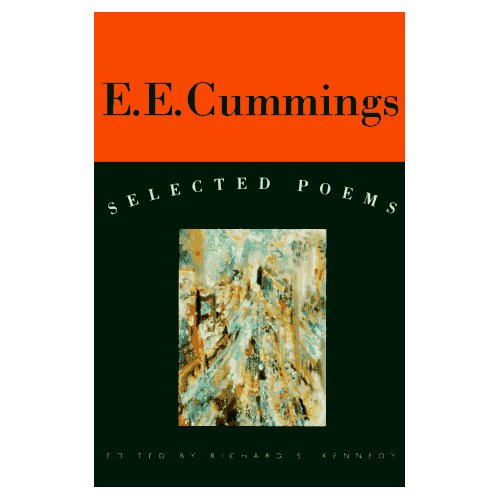
The book is divided into categories and chronologically within those categories: A Child's World; Sweet Spontaneous Earth; The Poetry of the Eye; Portraits; Love and Its Mysteries; Achieving the Togethercolored Instant; Kitty, Mimi, Marj and Friends; The Dimensions of Being Human; Myths and Allegories; Urban Glimpses; Targets of Satire; and Endings. There is biographical information included in the introduction to each section that helps with context (not that context is necessary, I just like it). The book also features many of his sketches, since he was an artist too.

Here's one I like (found in the Sweet Spontaneous Earth section) that is not too complicated to reproduce:

may my heart always be open to little
birds who are the secrets of living
whatever they sing is better than to know
and if men should not hear them men are old

may my mind stroll about hungry
and fearless and thirsty and supple
and even if it's sunday may i be wrong
for whenever men are right they are not young

and may myself do nothing usefully
and love yourself so more than truly
there's never been quite such a fool who could fail
pulling all the sky over him with one smile

Book of Longing

| On
Monday, August 21, 2006
by Leonard Cohen #25

do not read this book if you are any of the following: blissfully happy, mordantly depressed, anti-canadian, exceedingly prudish, or averse to self-portraits.

do read this book if you are: in the perfect receptive state of melancholy, a lover of poetry, a leonard cohen fan, not prudish, curious about how many drawn self-portraits can be inserted in a book of poetry (answer: read it to see).

When I started reading this volume, I was not that into it. I realize now that I was just too happy for it to be a good fit in my reading list. Shortly after that aborted first try, events transpired and I found my mood heavier, but also more receptive to the dark but hopeful messages within. Of course at first it was TOO heavy and I had to put it down again because it made me want to stick my head in the oven. (Book of Longing is no joke as a title. I found myself mourning things I didn't even know existed. But I suppose that kind of discovery is the whole point of reading in the first place.) Finally, equilibrium was found between black mood and buoyant heart and I was able to read it all pretty much in one go.

I wouldn't recommend this if you are looking for something to cheer you up (although one could argue that if you're looking to Leonard Cohen for sunshiny cheer you get what you deserve). However, if you are in an emotionally nebulous state and looking for something to read, Cohen is great company. It's not all doom and gloom; he's often quite funny in a dark dry way. He can articulate the confusing chambers of the human heart like few others.

here's one that I liked (there were many, but this one popped out at me as I write this). I am particularly drawn to the last stanza (verse?).

The Sun

I've been to the sun
It's nothing special
A place of violence
Much like our own

The sun said
I am an open book
Be patient

You will find
That everything happens
The same way
Here and there

The solar winds
Are something else
No one masters them
No one really
Navigates them

You survive them
Or you are never
Heard from again

I love the way
The sun speaks
It is so calm and honest
Except when seized
By its own misfortunes

The Year of Yes

| On
Tuesday, August 15, 2006
by Maria Dahvana Headley #24
(note: I have a stack of other books yet to be written up, but I've decided I'm going to try keeping up with the new ones, while catching up with the old ones. It might even work!)

I just finished reading The Year of Yes. Despite all of my recent "YES" evangelism, this was not a book I planned on reading, at least not any time soon. Headley's yes (say yes to any man who asked her out for a year) and my yes (try to get my head out of the sand in general) seemed so vastly different to me that it did not appear to be a must-read.

Another reason I wasn't in a rush: I've seen Headley speak twice in the past four months -- at Wordstock and Live Wire -- and honestly, I felt like I'd already heard it all. Sort of like attending a series of parties with someone who tells the same amusing stories. I get it, I've heard it -- you're quirky/feisty but vulnerable. However, a friend had the book from the library, finished it early and offered to lend it to me, so I said yes! It turns out that our yesses are not necessarily so different, despite the fact that thus far mine have not involved helping a transvestite in Marie Antoinette drag navigate a bathroom stall. (did I mention that in addition to quirky/feisty/vulnerable, she's also colorful to an almost wearisome degree?)

It was an interesting read. I spent half of the book really annoyed by her attempts to Make The Reader Love Her, but then she'd turn it around by admitting she was doing it, or blurting out something that really struck home with me about being more generous of yourself. That these moments fell between descriptions of her unconscious wiggle walk and her general adorableness is just the way it is. Actually, I think I ended up liking her more, or trusted her more anyway because she kind of pissed me off from time to time. It adds a certain veracity, I guess.

My favorite of her date stories was definitely Journey To a Ten Cent Universe, in which she accompanies a train conductor to Coney Island for the last day of the summer season. Not just because of the bedraggled amusement park atmosphere (although I very much enjoyed that), not just because there's an iguana (!) and a cupcake, but also because she has her big epiphany there. Or at least the epiphany I found most relatable. The whole episode is strange but sweet.

Ultimately, I found the message of Yes to be one of breaking out of old patterns and habits even when it hurts, which god knows is difficult. The success of Yes requires a kind of bravery and a willingness to be vulnerable that I find somewhat terrifying. Perhaps I should have started with a Just Say Maybe campaign!

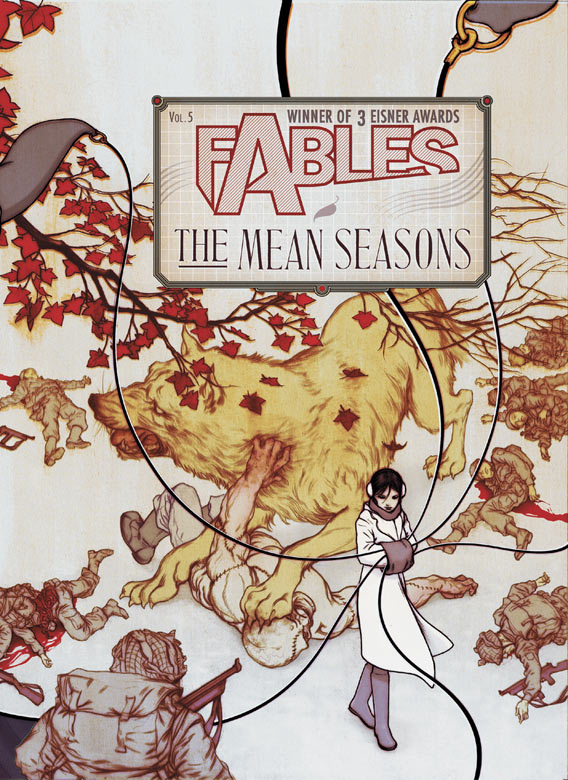
Fables Vol 5: The Mean Seasons

| On
Monday, August 14, 2006
by Bill Willingham #23

This is the fifth trade paperback collection of the Fables comic by Bill Willingham. I enjoy this series so much! The premise is that fairy tale characters are real and have been driven from their homelands by "The Adversary." They now live in exile in Manhattan and upstate New York. (The characters who cannot pass as human live on "the Farm") They have a government -- King Cole is the mayor, Snow White is the deputy mayor, Bigby Wolf is the sheriff, Rose Red (Snow's little sister) runs the farm, and so on. Prince Charming is an idiot himbo who has constant woman trouble (three x-wives -- Snow, Sleeping Beauty, Cinderella), and the other troubles that being an idiot himbo will bring. In this particular volume, we get to see the results of his foray into politics. (I promise you he is more entertaining than the real idiot himbos we are forced to observe modern American politics.)

One of the things I like about this series is that it recognizes the inherent darkness in the old fairy tales. There are continuing story lines dealing with The Adversary and the politics and interpersonal intrigues of Fabletown, but Willingham will also digress into backstory and take side-trips to lesser-known aspects of well-known characters. This particular collection is mostly about the mayoral race, Snow giving birth, and a story about Bigby and WWII. (It works, I promise!) If this sounds interesting at all, I would definitely recommend starting with the first in the collection Fables Vol.1: Legends in Exile.

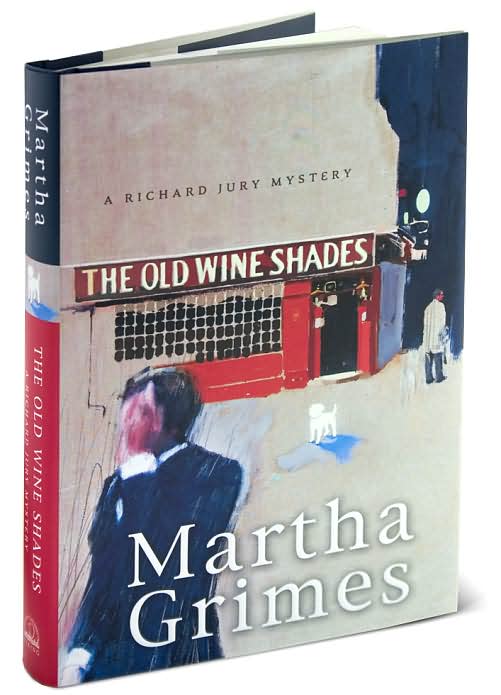
The Old Wine Shades

| On
Monday, August 07, 2006
by Martha Grimes #22

I miss mysteries! I hardly read them anymore, and I'm not sure why. That being said, I always like reading Martha Grimes. This is her twentieth Richard Jury novel. TWENTY! That's a freaking lot. Grimes seems to have found a way to keep things interesting for herself, which in turn is interesting to me. I know this probably irritates some long-time fans of the series, but I'm okay with less hypochondriac Wiggins in every novel, with less procedural, with less Mysterious Woman To Whom Jury Develops a Romantic Attachment Therefore She Must Die In a Sad Yet Predictable Fashion. There's still plenty of Melrose (I heart Melrose), still cameos from the Long Pid gang, still animals and children, and still that hint of romance -- but now with some characters who've been hanging around for ages and not new Jury Romance Cannon Fodder. (it sounds like I'm Jury Relationship obsessed... I'm not really, but she does manage to make it an issue without it being The Only Issue.)

This particular story involves a chance encounter, a missing boy and his mother, a psychic dog named Mungo, wine (duh), Schrodinger's Cat, a mental institution, a sociopath, the smoking room at Boring's, and the set up for a future nemesis for Jury. (nemesis! so exciting!!) But best of all is the melancholy people-are-awful-but-also-occasionally-wonderful world she's created. (I always end up laughing out loud at least once when reading one of her novels, which I appreciate.)

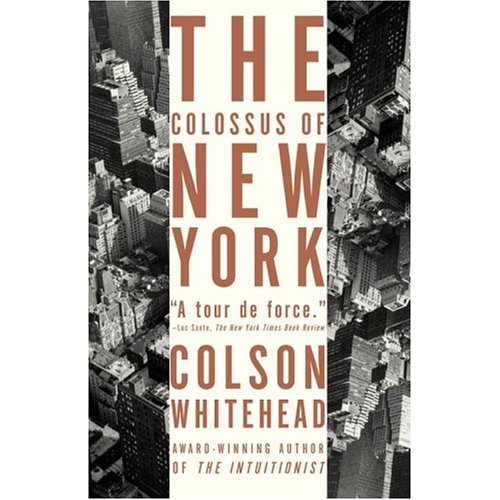
The Colossus of New York

| On
Sunday, August 06, 2006
by Colson Whitehead #21

I began reading this collection in April shortly after I saw Whitehead read at Wordstock. It was a bit of a slow start for me (witness the four months it's taken me to actually finish reading it), but I put that down to getting sick in early May. My light-headed delirium did nothing to add to the already delirious prose (his delirium is the good kind, though). After that I got distracted by other books and you know how it goes.

These thirteen... well, they're not really essays, not fiction, but not NOT fiction either... it's sort of like tuning in to a specific New York frequency. It's not the only station, but you get a pretty good idea for certain rhythms and attitudes. The thirteen (whatever they ares) cover many aspects of the city: geographical (Central Park, Broadway, Coney Island, Brooklyn Bridge, Times Square, The Port Authority, Downtown, ), chronological (Rush Hour, Morning), elemental (Rain), or combinations including some or all of the above and that alchemical something else that makes a place uniquely itself. On the other hand, some things outlined are the stuff of life that happens to a person anywhere.

As I was finishing this collection, I finally got smart and started marking some of my favorite passages. He has a sort of loose yet controlled layered and rhythmic style -- it's like one long spoken word prose poem.

from Coney Island: Please adjust: parts squeezing out of bathing suits, parts having natural reactions to changing temperatures, the bashful edges of the towel, your attitude because it's really getting on my nerves I go to all this trouble why can't you enjoy yourself for once.

+Off season this place is dead. Don't tell anyone, but the Wonder Wheel is a gear in the great engine of the metropolis and when it stops moving systems fail. Amusement park rides are disguises for other things.

from Rush Hour : In buildings comprised of other buildings' thirteenth floors, sinister transactions unfold.

from Downtown: The DJ has scrutinized evolution and knows the back door into reptilian brain-stem.

+If the victims all got together they could trace back their misfortunes to this cursed payphone. It's the only one for miles in working condition and everything people say on it turns out bad. Urgent telegram from the Ministry of Unhappy Thoughts: Been Thinking Stop No Good Will Come From This Stop.

+Gargoyles have clambered down from rooftop aeries to replace his friends but he's not sure if he should do anything about it because they're quite funny actually and much more supportive than his real friends.

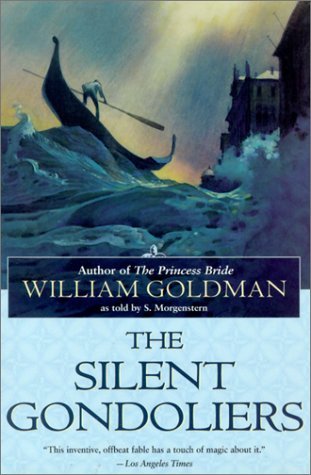
The Silent Gondoliers

| On
Tuesday, August 01, 2006
by William Goldman #20

This is a fun, quick illustrated fable about the glory days of the singing Venetian Gondoliers and why they stopped singing. From the back: Here... S. Morgenstern reveals the fascinating truths about John the Bastard, Laura Lorenzini, the centenarian Cristaldi the Pickle, Enrico Caruso, Porky XII, the Great Sorrento, the Queen of Corsica--and, of course, the one and only Luigi.

It's no The Princess Bride, but what is?